While some students discover Orthotics and Prosthetics (O&P) early in their academic journey, some find their way into the profession through unexpected experiences. In this podcast, we’ll learn more about current O&P students and their unique path to how they discovered this profession and what ultimately led them to Drexel's O&P program.
Gianna Bartolomei: I am a second-year O&P student at Drexel University, and I received my undergraduate degree at the College of New Jersey in biomedical engineering.
Chris Lynch: I'm a third-year student, a resident with the Drexel O&P program and I graduated with my bachelor's in economics from Drew University.
Darryl Icenhour: I'm a first-year student here at Drexel and I received my undergrad in exercise science with a minor in psychology.
Q: For those who may be unfamiliar with Orthotics and Prosthetics, how would you describe this profession?
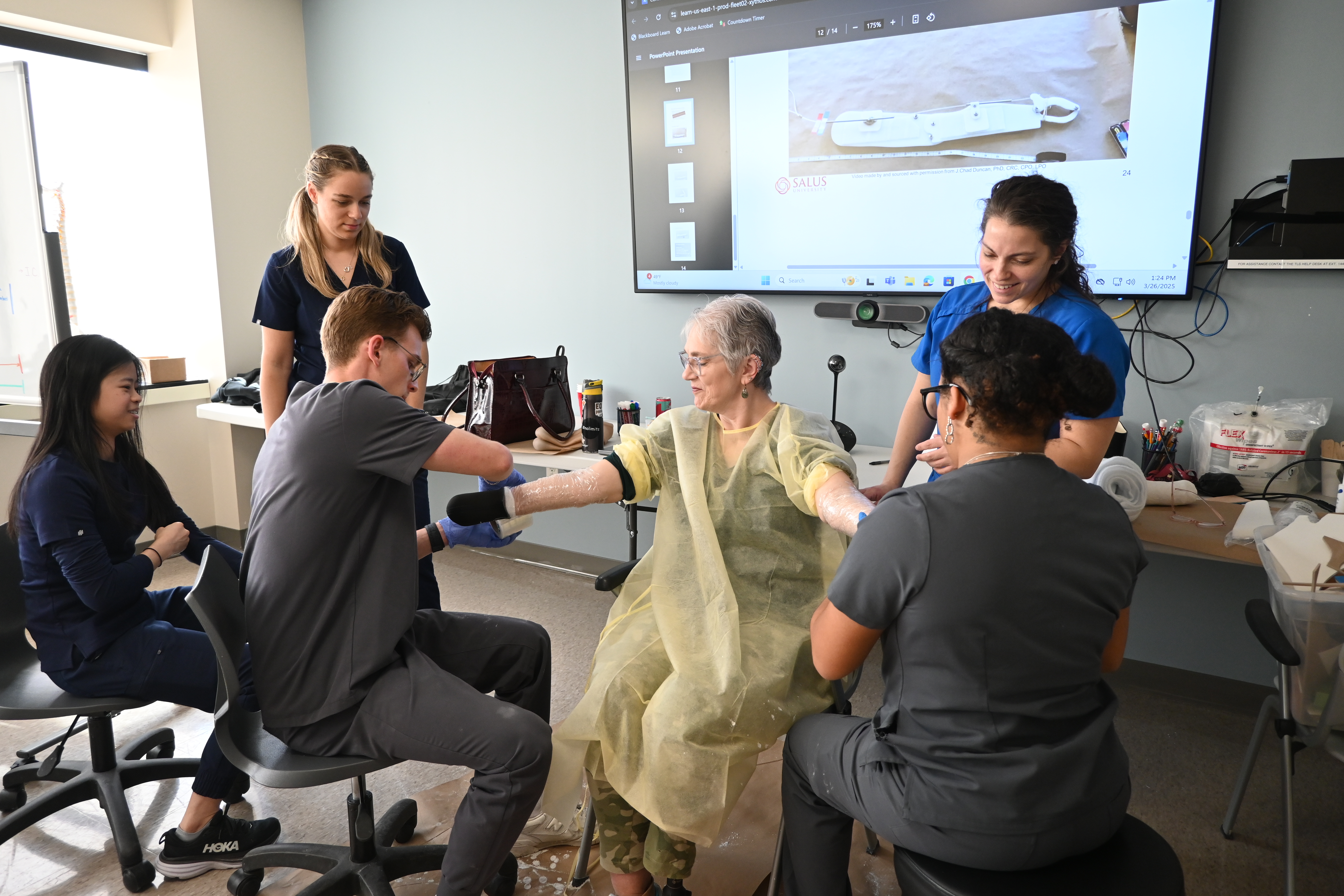
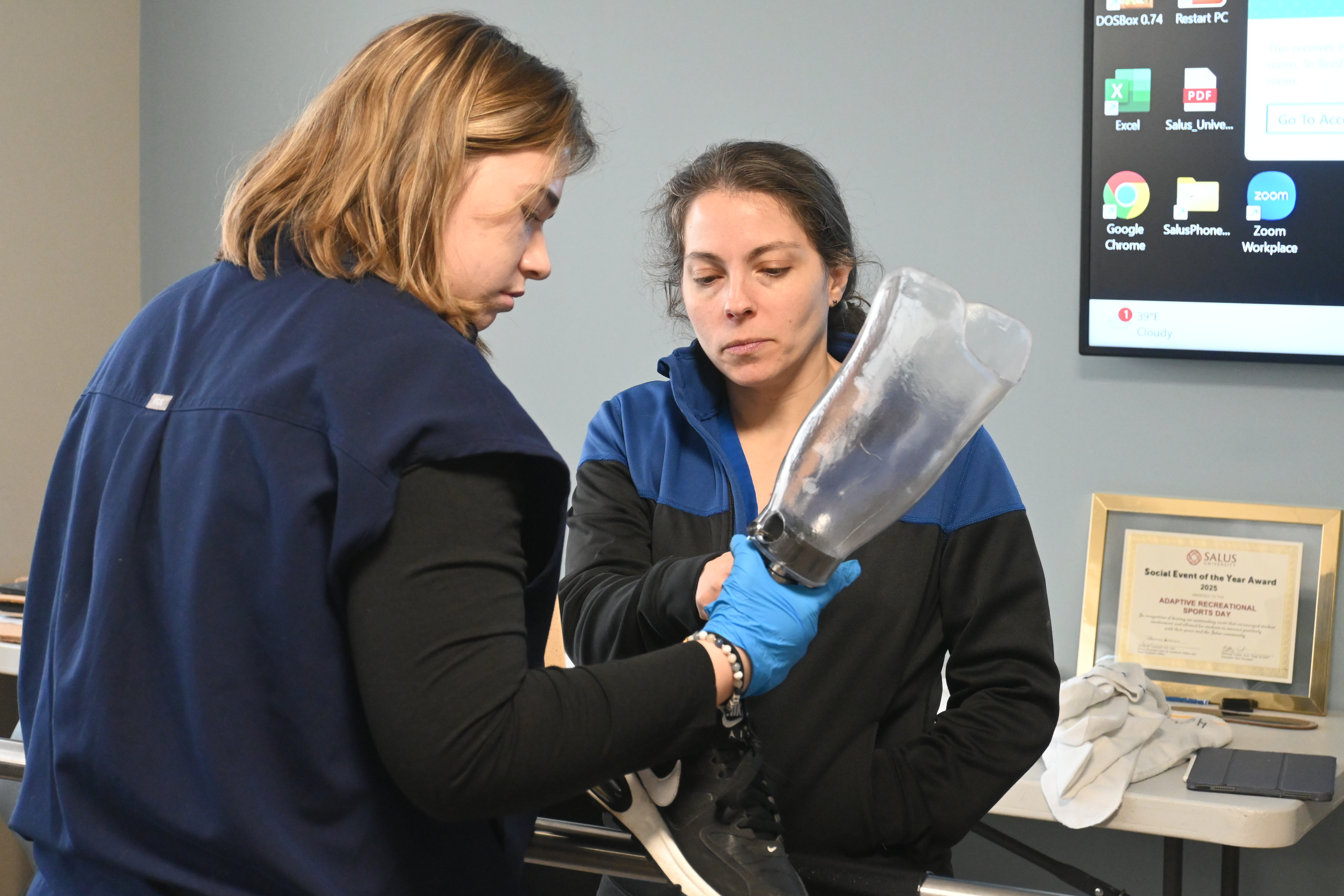
Lynch: I always used to joke and say that O&P is like scientific arts and crafts, but in reality we provide devices that either replace missing limbs or body segments or devices that help align or realign a body segment.
Q: Did you all envision yourself pursuing this career in Orthotics and Prosthetics? Can you describe your academic journey?
Icenhour: No, I didn't even know about this career until about 10 years after I had already joined the military.
Lynch: It's more of like a family journey for me. I graduated in 2010 and I had been working with my dad who was an orthotist for over 40 years. So I had exposure through him pretty much my entire life.
Q: Gianna, I know from your background, it seems like you had an idea right from the start. Can you talk a little bit about that?
Bartolomei: It was kind of from the start. I actually did biomedical engineering with the envision of doing pediatric medical devices, so anything that you would see in a hospital. I actually went to a technical seminar and it was a certified prosthetist orthotist, and as soon as I saw the pediatric devices I knew that it was for me.
Q: That's so cool to hear everyone's individual journey. Darryl, can you tell us a little bit about your military experience and the role you served in?
Icenhour: I was an undesignated airman when I first joined; I worked in damage control. Eventually, I cross rated to become a hospital corpsman and then I further specialized to become a physical therapist technician, performed rehab on active duty and reserve people to try to regain their function, increase their exercise routine and return to whatever activities they wanted to do.
Q: Working with injury service members and maybe veterans, is that kind of what sparked your interest in Orthotics and Prosthetics?
Icenhour: One of my commands was Naval Medical Center Portsmouth. There, I worked with the Wounded Warrior Project and did group exercise programs with them. At that command, I met an orthotist and I saw him doing a cast and I was like, "What is that guy's job and how do I do that?" But I started talking to him and found out some more about the field and that's when I changed my degree to get a bachelor's, something that was comparable. And then when I was at Walter Reed for my last command, that's where I did all my shadow hours to confirm I still wanted to do that.
Q: Were there any challenges or uncertainties you faced while trying to change your career paths?
Icenhour: There were a few, right? I don't know if you can tell, but I am 40 years old. So the fear of not fitting in or I'm 20 years older than most of the people in my cohort, but that hasn't been an issue. Other than that, I had to navigate retirement and taps requirements, all these different things, plus figure out moving logistics all while I was still doing my normal job. So there were many, many difficult things to do, but you just had to keep going.
Q: Chris, I know you had also an untraditional route into Orthotics and Prosthetics - you studied economics and minored in sociology. At what point did you begin considering a career in healthcare?
Lynch: I graduated at the time when all I was really finding with that particular degree were sales positions that were really not appealing to me at the time. I had been working part-time with my dad who was an orthotist and at some point he said, "You got to go out and find your own job. Why don't you go talk to this guy who I used to work for?" And I was there with them for almost nine years. So I didn't really decide on it. It just sort of happened.
Q: As a first-generation college student, what was your experience navigating higher education and admissions, and figuring out what you needed to pursue an Orthotics and Prosthetics program?
Lynch: The requirements were fairly well listed on the website, but it was a little daunting because I'd been out of the academic setting for 14 years at that point. But aside from that, just getting in the routine of understanding what's expected of me and making a priority to study the material as soon as possible. I have a three-year-old at home and when I started, she was only one and a half, so it was a little hard.
Q: How has your background in economics and sociology shaped the way you interact and approach patient care?
Lynch: I think they both played an important role in how I approach things. Sociology is the study of people and the systems that people use. Economics was more understanding the way the world works from a financial kind of perspective. It sort of gave me a better predisposition to work with people, I think, but then also understanding the insurance side of things.
Q: Gianna, I know you got your undergraduate degree in biomedical engineering. How'd you come to that decision because it seemed like your path into O&P, you had some idea that you wanted to go into healthcare. What impacted that decision to pursue biomedical engineering?
Bartolomei: My little sister was born with Down syndrome. Growing up, I always knew of the therapies and different devices that were out there for kiddos with special needs, so that kind of locked into place that I wanted to do something in terms of pediatric healthcare. Then I went to a technical seminar, it was a certified prosthetist orthotist, [and I] absolutely fell in love with it. We were passing around the teeny tiny little baby Ankle-Foot Orthosis (AFO) and I completely fell in love, but then going and getting my shadowing hours truly locked into place for me. Seeing these devices change people's lives from baby all the way up to adults really solidified the fact that I could change lives with this.
Q: Gianna, can you talk a little bit about your experience at TCNJ and what projects you pursued to strengthen your application to get into an Orthotics and Prosthetics program?
Bartolomei: My experience in biomedical engineering was definitely more medical engineering than bio. I actually only took two technical bio classes, so I took a lot of circuits and systems and all sorts of calculus. When it came to my junior year, it's about that time where we start to put together our capstone project and our senior project. For biomedical engineering, that project is to invent a medical device. And that's kind of crazy to ask, especially in the 21st century because what's not out there? I worked together with a team of three other girls, one who's actually a first-year in the program right now, and we made an adjustable lower limb socket for patients who experience limb fluctuations in their socket. It used sensors to feel what the pressure was inside the socket and it allowed the user to manually loosen the socket when that sensor went off.
Q: Were you able to see and prototype the product to see how it helped real life patients?
Bartolomei: We were able to come up with a final prototype. It was a 3D printed carbon fiber socket with a jerry rigged ratchet system and sensors on the inside, and it was able to actually work. We made a few different sizes of a fake residual limb and we were able to make sure that it would set off the sensors, which is really cool. And we ended up winning an award for the construction.
Q: How has that experience and project shaped your idea about how important personalized patient care is?
Bartolomei: When researching for the project, we actually struggled to find values for a lot of what we needed. So like, what the average change is in a residual limb and values like that. It really hammered in the idea into my brain that patients aren't a textbook. Everybody is different and it's important to get to know your patient first before you just go ahead and say, "This is what I'm going to put you in."
Q: Chris, how did you first hear about Drexel and the orthotics program here?
Lynch: A few years ago while I was working, the same colleague that got me interested in going back to school mentioned that Salus University had just opened a program and that a colleague of ours from a different office had just been accepted into cohort number two.
Q: So, that really sparked your interest and narrowed down what program and where you wanted to go?
Lynch: Yes, that and the proximity to where I was living at the time and my current family situation, it was all just the right time, right place kind of deal.
Q: Gianna, what stood out to you about Drexel compared to other programs that you considered?
Bartolomei: When I attended an online interest webinar, the word fun was used and I really liked that. The word competitive was never brought up once, versus some other schools. And I wanted an environment that was going to be open and was okay with me making mistakes, and it was just an overall fun experience. The fact that the word fun was used just really nailed it in.
Q: I know the professors here truly care about this program and I think they definitely foster an environment for their students to succeed and not feel the pressure that they're competing against one another.
Darryl, you have a pretty unique pathway into Orthotics and Prosthetics. Do you have any advice for prospective students that are still trying to figure out their own path?
Icenhour: I would say don't feel like you have to have everything figured out right this moment. What your current career is or your current degree doesn't necessarily mean you have to do that forever. Try different experiences, get yourself exposed to different things and you never know where you may end up. My last piece of advice would be to develop a nice battle rhythm of a study plan and if it's working for you, stick with it and make adjustments along the way if needed.