Centennial
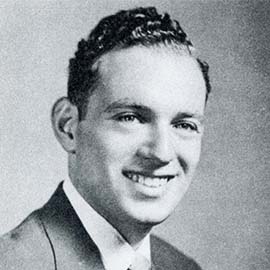 Growing up in Elizabeth, New Jersey, young Hal Wiener worked in a grocery-deli established by his oldest brother. At the age of 15 he found himself managing the store after his brother left to work for the government during the war.
“I knew retail wasn’t for me,” Dr. Wiener remembers today. “I wanted to help people.” He had heard that the Navy had a great electronic pre-engineering program and he entered it in 1945, a few months after basic training. He eventually realized he was not like his fellow engineering students, who “were all about the numbers,” and left the program.
After his Navy service, Hal returned home where he met the optometrist father of a friend and learned about the profession. He also learned about Dr. A.M. Skeffington , co-founder of the Optometric Extension Program (OEP), a post-optometric program study of Behavioral and Developmental Optometry, and known now as the “father of behavioral and developmental optometry,” a subject that intrigued him and formed the basis of Dr. Wiener’s optometric career.
He calls his acceptance to PCO “a miracle.” He had applied to Columbia University’s optometry program only to learn the school was closing and not accepting students. At work shortly after receiving that disappointing news, Hal was asked by a soda salesman why he was so down. Hearing Hal’s answer, the salesman told Hal he knew someone at the then Pennsylvania State College of Optometry (later shortened to Pennsylvania College of Optometry - PCO). He picked up the phone, called his friend, then gave the phone to Hal, who was told, “You have to come in and interview with me. When can you come?” Hal immediately answered, “How about three o’clock this afternoon?”
Dr. Wiener says later that same afternoon at PCO he saw a “dirty and disheveled man” and asked him for directions. He still laughs at that memory because the “cleaner” turned out to be Dr. Jacob Nevyas, the College’s registrar and friend of the soda salesman, who had been cleaning his chemistry lab.
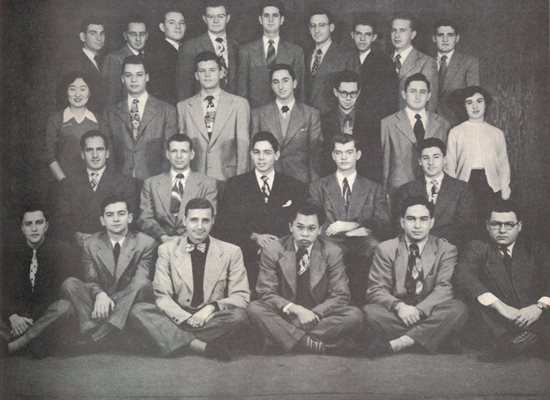
During his interview Dr. Wiener remembers that Dr. Nevyas was almost discouraging, as he explained that a.) Hal would have to go to college for certain science courses (because this was a four-year program compressed into three years), and b.) There was a long waiting list for what was to be the College’s last wartime accelerated OEP program. Despite this, Hal was told to send Dr. Nevyas his high school transcript, and a few months later his Class of 1950 acceptance letter arrived.
A classmate who later became a good friend, Elwood Kolb, brought his cousin, Ruth Wendkos, to an early PCO party and Dr. Wiener says they “hit it off right away.” They were married for 36 years before Ruth passed away. At a later party, he introduced Ruth to his favorite PCO professor, Dr. Nevyas, whom he notes had a “phenomenal memory.” When Dr. Nevyas met Ruth, he informed her that he knew her research chemist father - and that Ruth and Dr. Nevyas were in fact 23rd cousins.
In remembering Dr. Albert Fitch, Dr. Wiener credits him for his fight to advance optometry and establish PCO. “I admired Dr. Fitch and am grateful for his persistence in following his dream of having optometry recognized within the health professions,” he says. He believes Dr. Fitch “established a firm foundation of learning that has helped all optometrists… allowing us to explore all effective approaches to serve our patients, and to communicate with other health professionals.”
After graduation, Dr. Wiener went into practice as a behavioral and developmental optometrist. He feels strongly that PCO was an excellent school that delivered a strong basis that prepared you for anything ahead, which was the reason he wanted his son (Marc Wiener, OD ’83) to go to PCO. He also believes that “learning the basics prepares you for the real learning that takes place once you have graduated.”
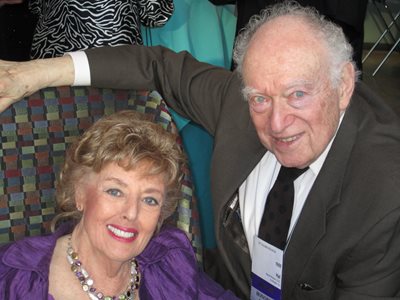 Dr. Wiener’s continued support of PCO included terms as president of the PCO Alumni Association (1990 and 1991), and a member of the Board of Trustees (1992 through 1994). He also established the Harold and Ginny Wiener Scholarship in 1999, named for himself and Ginny, who has supported PCO and optometry alongside Dr. Wiener for 30 years now.
He has received many awards, including a President’s Medal at PCO 75th Anniversary; Optometrist of the Year; the PCO Alumni Association Award; Outstanding NJ Optometrist (the E. C. Nurock Award, 1995) - the highest symbol of recognition from the New Jersey Society of Optometric Physicians; and the prestigious Dr. Gerald Getman Award for contributions to Behavioral and Developmental Vision from the College of Optometrists in Vision Development. He has written three books for the Optometric Extension Program and one for the general public, “EYES OK-I’M OK”.
Though Dr. Wiener is quick to credit his PCO education because “it gave me my start,” the real clue to his distinguished 63-year career is the man himself: “What mattered to me was how could I help my patient.”