Current Student News
Optometry
General News
Alan Kabat, OD ‘90, FAAO, loves the Southeastern Educational Congress of Optometry’s (SECO) annual conference. But he admits to be somewhat biased in that regard.
Before returning to the University’s Pennsylvania College of Optometry (PCO) as a professor in 2018, Dr. Kabat had been a professor at Nova Southeastern University in Florida and at Southern College of Optometry in Memphis, Tenn., for a combined 25 years. And, he was the faculty liaison for both schools, tasked with getting faculty and students excited about going to the southeast regional conference.
 “SECO is just real doctors, real practitioners, and they come with the intent that they want to learn something practical,” said Dr. Kabat. “They come to classes and want to learn; they go to the exhibit hall and they want to buy; and when the hours are over and it’s social time, they want to socialize. They basically come with the intent of doing everything 100 percent.”
Dr. Kabat, who attended his first SECO conference in 1996 and conducted his first lecture at the conference in 1999, was part of a group from Salus PCO that attended this year’s SECO conference March 4-8 in Atlanta, Ga.
He presented a number of lectures on topics such as dry eye; biological medications in eye care; uveitis (a form of eye inflammation); and two workshops, one on amniotic membranes and the second on Meibomian Gland Dysfunction (MGD).
The goal of SECO is to bring together optometrists and optometric staff from across the country and the world to learn about the latest research, innovations and techniques in the optometric profession. Courses cover the latest scientific and clinical advancements, key practice management issues and hands-on learning. Optometrists can choose from hundreds of hours of continuing education courses, hands-on learning labs and state-of-the-art special sessions.
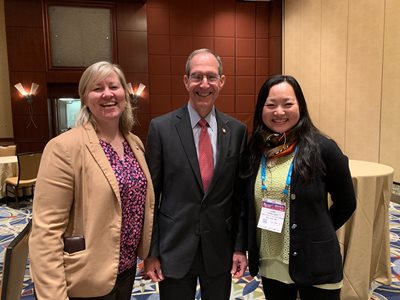
Among those attending from Salus PCO were dean Melissa Trego, OD ’04, PhD; Alissa Coyne, OD ’10, FAAO, Resident ’11, PCO assistant professor ; Andrew Gurwood, OD ’89, FAAO, Resident ’90, co-chief of Suite 3 and PCO professor; Laine Higa, OD, Resident ’15, PCO assistant professor; Holly Myers, OD ’86, Resident ’87, chief of Primary Care, Suite 1, and PCO associate professor; as well as residents Candace Evernden, OD, ’20Resident; Justine Adriaansen, OD, ’20Resident; Lucinda Kauffman, OD ’19, ’20Resident; and Megan Rother, OD, ’20Resident.
 “The Southeastern Educational Congress of Optometry enabled me, as well as optometry residents across the country, to partake in an invaluable experience at no cost, something so important to us as residents who are seeking to learn in order to become the best optometrists we can be,” said Dr. Rother.
SECO offered not only a variety of courses — including, but not limited to, visual field and OCT interpretation in glaucoma, indications for and interpretation of topography images, diagnostic imaging in relation to macular degeneration and up-to-date information regarding therapeutic drugs — for the residents, as well as a poster program, according to Dr. Rother.
“We were provided not only with the chance to obtain required hours of continuing education, but also the opportunity to expand our knowledge and to gain clinical tips and strategies essential to remaining respected in our profession by both patients and colleagues,” she said.
For the second year, Dr. Coyne also represented the American Society of Optometric Surgeons (ASOS) at the conference. A co-founder of ASOS, Dr. Coyne said the group’s goal is to provide a place for networking, hands-on education through workshops, and to promote the collaboration and development of individuals that have a shared common interest.
 “In some states, optometrists can do minor surgical procedures, including certain laser procedures and certain lid procedures. These skills are being taught in the schools at this time,” said Dr. Coyne.
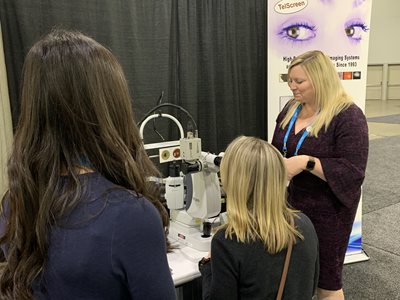
ASOS had a booth in the exhibit hall with two lasers that were loaned to the group for the conference. “Practitioners could come to the booth to learn more about the society and also to fire the lasers,” said Dr. Coyne.
Although it’s a smaller, regional conference, Dr. Coyne said it’s a tremendous opportunity for networking. “There ends up being courses for optometrists, para-professionals and students. I think they provide a wide array of the different content of continuing education,” she said. “Anytime that you talk about a conference, I always think that it’s a good way to network for individuals. I ended up getting involved with these other optometrists because I had a common interest in advanced procedures. And of course that drew me to other individuals from other schools.”
She added that networking aspect was among the reasons for establishing ASOS. “Sometimes your best clinical experience, or your best clinical input, ends up coming from having a conversation with other professionals or other optometrists, rather than sitting in a classroom,” said Dr. Coyne.
Dr. Kabat agreed.
“I tell the students all the time, if you’re looking to meet people and get hired, and find out about practices and networking, SECO is the meeting to go to because that’s where people are and they’re often looking for new associates,” said Dr. Kabat. “That’s where doctors go to really network, at least those from the Southeast region.”
The University's Alumni Association also hosted an event during the conference that attracted approximately 70 alumni and friends to the ballroom at the OMNI Atlanta hotel.
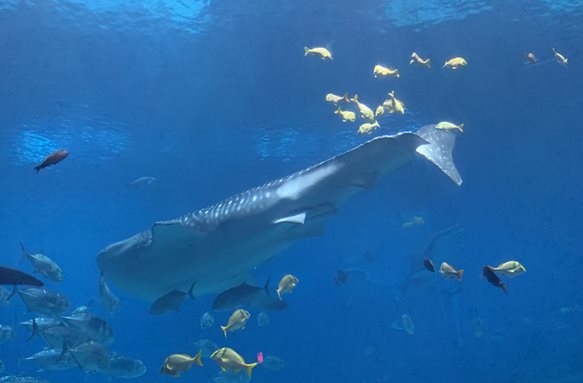
It wasn’t all work and no play for Dr. Coyne. She arrived a day early in Atlanta and was able to take in the Georgia Aquarium, the only aquarium in the Western Hemisphere where visitors can see whale sharks.
“They’re very slow-moving animals. People were able to snorkel with the whale sharks at the aquarium. Unfortunately, I missed out on that opportunity,” said Dr. Coyne. “I spent three hours there and it was my favorite thing. That was my fun little moment.”