Drexel University, Elkins Park campus, offers two Post-baccalaureate programs, one in Health Sciences and one in Speech-Language Pathology (SLP).
Post-bacc in Health Sciences
The Post-baccalaureate in Health Sciences program offers students interested in pursuing a graduate or professional degree in the health sciences an opportunity to strengthen their scientific background or use it as a record enhancer, boost their CV, or earn prerequisite course credits. The biggest advantage to completing the program is that it makes a student a competitive applicant for any health professions program to which they apply.
The Post-bacc program provided Corey Ryan, PBHS ‘21, OD ‘25, the time and opportunity to focus and help him figure out what he wanted to do with his career.
 “I knew I could do it; it was just a matter of figuring out how to do it,” he said. “And, that’s what the Post-bacc program did for me: it allowed me the time to figure it out. Without that, I wouldn’t’t have done as well at the Pennsylvania College of Optometry (PCO), because I gained that confidence of being able to handle the next level.”
The competitive 30-week traditional program helps develop each student's scientific skills and foundational knowledge in basic health professions sciences while also exposing them to patient care experiences in a variety of settings and disciplines.
Students accepted into the Post-baccalaureate program who successfully complete the certificate, submit a complete application, and meet all prerequisite requirements are guaranteed an interview for a program of their choice on the Drexel University, Elkins Park campus.
Post-baccalaureate students must complete 28 credits while maintaining good academic standing (a GPA of 3.0 or higher and no more than two 'C' grades) to complete the certificate program.
“Many students from our previous cohorts are currently enrolled in professional programs such as optometry, audiology, occupational therapy, medical, orthotics and prosthetics, physician assistant and nursing both here at Drexel as well as at other schools across the United States,” said Darryl Horn, PhD, FAAO, director of the Post-baccalaureate program in Health Sciences and director of the Biomedicine graduate programs.
Post-bacc in Speech-Language Pathology
The Post-baccalaureate program in Speech-Language Pathology (PBP-SLP) is designed to prepare students to excel academically and professionally by providing a rigorous, holistic, and comprehensive experience that will establish a foundation necessary for success in the SLP profession. Students in the program are eligible to pursue two career options: Speech-Language Pathologist (SLP) and Speech-Language Pathologist Assistant (SLPA).
What Sets the Post-bacc Program in SLP Apart?
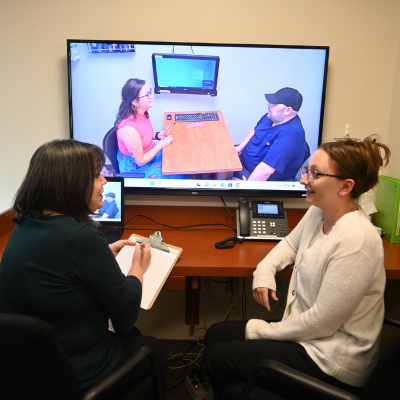
 Observation hours embedded within the coursework with a variety of clinical populations. The Speech-Language Institute (SLI), the on-campus clinical facility of the Master of Science in Speech-Language Pathology (SLP) program, provides students with opportunities to observe clients across the lifespan who have a wide range of communication and feeding/swallowing disorders. “By adding the patient-care experience, which is for both the Health Sciences and the SLP Post-bacc programs, that will really set the Drexel Post-bacc students apart on the Elkins Park campus,” said Robert Serianni, MS, CCC-SLP, FNAP, chair and director of the SLP program.
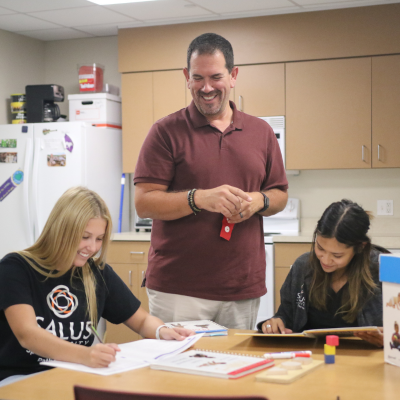
- Individualized attention.Classes are small and held primarily face-to-face on the Elkins Park, Pennsylvania campus. Your advisor will help you explore your interests and develop professional goals.
- Fieldwork experience for future Speech-Language Pathology Assistants (SLPAs). Students who take Drexel’s SLPA preparation courses acquire clinical fieldwork hours on-and off-campus in a highly supported environment that hones their skills.
- A solid foundation for future SLPs.Students who are graduate school-bound will complete coursework designed to introduce them to clinical methods across the SLP scope of practice, increasing their preparedness for clinical training.
- SLP graduate program acceptance.Students accepted into the Post-baccalaureate Program in SLP with an overall GPA of 3.5 or higher from their undergraduate institution will be automatically accepted into the SLP Master of Science (MS) graduate program upon completion of the PBP-SLP certificate, given that the following conditions are met:
- Maintain an overall GPA of 3.5 or higher in the PBP coursework
- Earn a grade of "A-" or higher in Clinical Methods and Observation in SLP 1 & 2
- Complete the admissions requirements for the MS program, including a successful interview.
What is an SLP?
 Speech-language pathologists are health care professionals who assess, diagnose, and treat speech and language problems as well as swallowing disorders according to the American Speech-Language-Hearing Association (ASHA). They provide services to clients with disorders in the following areas:
- Speech disorders, including articulation problems, fluency (e.g., stuttering) disorders, and voice problems
- Language disorders, including receptive/expressive language, spoken and written language, and social/pragmatic language
- Swallowing disorders, including pediatric and adult feeding disorders
- Cognitive disorders, including dementia
How can the Post-baccalaureate program in Speech-Language Pathology help me become an SLPA? It provides students with all of the necessary content-specific coursework required to become an SLPA. Completion of SLPA Practicum 1 and 2 fulfills the academic equivalent of the ASHA Assistant Modules, the prerequisite courses, the clinical field work requirement, and prepares students to take the SLPA national exam.
How can the Post-baccalaureate Program in Speech-Language Pathology help me become an SLP?
It provides all of the content-specific coursework accredited graduate programs require for admission. Required observation hours (25) are also integrated into the program. In addition, program faculty and advisors assist students in developing their application materials, including resume prep and interview practice, for successful admission into graduate school.
“We are proud to say that every one of our PBP-SLP graduates has been offered multiple acceptances into graduate schools across the region,” said Serianni. “It is nice to see that the majority choose to stay on to complete their degree here at Drexel, which speaks well of the program’s faculty as well as the classes and clinical aspects of the PBP-SLP.”