
Optometry
Drexel
General News
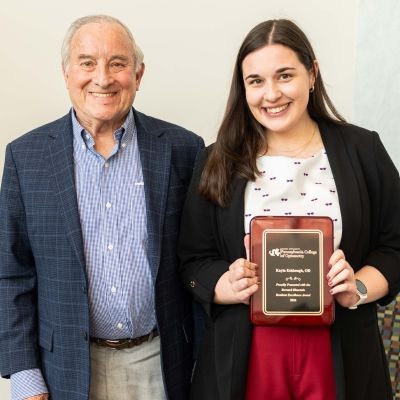
The Office for Faculty Excellence and Academic Culture at Drexel University has named Elise Ciner, OD, FAAO, professor at the Pennsylvania College of Optometry (PCO) on the Elkins Park, Pennsylvania campus, and co-director of the Special Populations Assessment and Rehabilitation Center at The Eye Institute, as the 2026 Provost Award winner for Outstanding Advanced-Career Excellence in Research, Scholarship, and Creative Activity.
Dr. Ciner has been one of the most active of the College’s investigators over the past two decades, conducting ground-breaking research related to vision screening in pre-school children and other studies, including an investigation on the effects of uncorrected moderate hyperopia on early childhood development.
 “I feel honored and proud for PCO, for optometry, and for women in optometry,” said Dr. Ciner. “It’s a great privilege to be recognized for my scholarly activities as an optometrist from such a prestigious institution as Drexel University.”
PCO has changed over the years, she said, growing from a smaller institution that was just starting to embark more heavily into research upon my arrival to now being part of an R1 research institution after officially merging with Drexel in July 2025.
She cited the encouragement to expand research efforts and mentorship from legendary PCO educators including Anthony Di Stefano, OD ‘73, MEd, MPH, FAAO, vice president emeritus; Felix Barker, OD, MS, FAAO, professor emeritus; Mitchell Scheiman, OD, PhD ‘16, FAAO, senior associate dean of Research at PCO/Drexel; all under the leadership of Thomas Lewis, OD ‘70, PhD, FAAO, president emeritus.
Dr. Ciner initially received funding to develop a test for stereopsis (depth perception) for children. There are currently five versions of the PASS test (Pediatric Assessment of Stereopsis with a Smile) used in research, vision screening, and clinical practice, including a Special Olympics version, allowing clinicians and researchers nationally and internationally to measure stereoacuity in previously challenging-to-test populations.
“Over the years, our institution grew and under the leadership of Dr. Scheiman, research in pediatric optometry was strongly encouraged as we became involved in larger collaborative inter-disciplinary, multi-center studies with funding from the National Eye Institute (NEI), National Institutes of Health (NIH),” said Dr. Ciner.
Dr. Ciner was a principal investigator (PI) on all three phases of the groundbreaking Vision in Preschoolers (VIP) study funded by the NEI/NIH.
“We designed the VIP study to answer questions with respect to the best screening practices to identify children at risk for prevalent and treatable vision disorders (amblyopia, strabismus, and significant refractive error) and therefore would benefit from early detection,” she said. “Our goal was to empower communities by identifying new technologies along with traditional tests that worked well when administered by nurses and lay screeners who are often engaged in community and school-based screenings.”
They were also awarded supplemental funding from NEI to purchase identical 38-foot fully equipped mobile medical units at each of the five clinical sites across the country to conduct the study on location at participating Head Starts and preschools to increase access to care.
About a decade later, Dr. Ciner was a co-principal investigator of another NEI/NIH research study on the effects of uncorrected moderate farsightedness on preschoolers’ early literacy. The results of the Vision in Preschoolers – Hyperopia in Preschoolers (VIP-HIP) study linked uncorrected farsightedness to early literacy deficits in preschoolers. Both the VIP and VIP-HIP studies were successful and resulted in 40 scientific publications due to longstanding collaborative efforts between leading pediatric ophthalmologists, optometrists, vision scientists and biostatisticians at clinical and research sites across the country.
In addition to the VIP and VIP-HIP studies, Dr. Ciner was a PI (subcontract with the University of Pennsylvania through NIH) for the Genetic Studies of Myopia. She also led the Vision Rehabilitation in African Americans with Central Vision Impairment (VISRAC) Study, a randomized clinical trial funded by the Pennsylvania Department of Health, and served as the clinical site principal investigator for the National Science Foundation‐sponsored Vifant Vision Acuity Screening Digital Platform Study.
She currently serves as a PI under the leadership of Marjean Taylor Kulp, OD, MS, distinguished professor at The Ohio State College of Optometry, for the NEI/NIH-funded feasibility study titled ‘Identification of School‐age Eye Problems Evaluation (ISEE)’, which is evaluating the best ways to detect vision problems in school-age children.
Dr. Ciner is an author on 97 scientific publications or book chapters, more than 140 scientific abstracts, and is a Fellow of the American Academy of Optometry (FAAO). She is looking forward to maintaining her current research collaborations, answering new research questions, and inspiring the next generation of optometric clinical investigators at the Pennsylvania College of Optometry at Drexel University.