General News
Alumni News
Blindness and Low Vision Studies
John Mabery ‘27VRT calls it “the helper gene.” And for those who have it, the Independent Living Skills Vision Rehabilitation Therapists course is a perfect place to practice it.
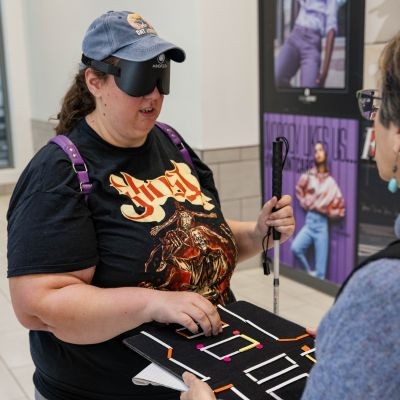
Mabery, a student in the Vision Rehabilitation Therapy (VRT) master’s program in the Drexel University’s Elkins Park campus, believes the Independent Living Skills course lab, which prepares students to provide comprehensive vision rehabilitation therapy services to blind or visually impaired individuals, is particularly important in highlighting the scope of what a VRT might be called upon to do.
“We want our clients to feel that they are capable of performing any task, no matter whether they are learning how to change a lightbulb for the first time or are relearning the skill after vision loss,” said Mabery, who hails from northern New Jersey. He earned a bachelor’s degree in journalism from Long Island University Post Campus in 2007 and a master’s in disability studies from the City University of New York in 2021. “That is the foundation of this program. An adaptation can be created for any skill so that those with vision loss can live the life they hope to live.”
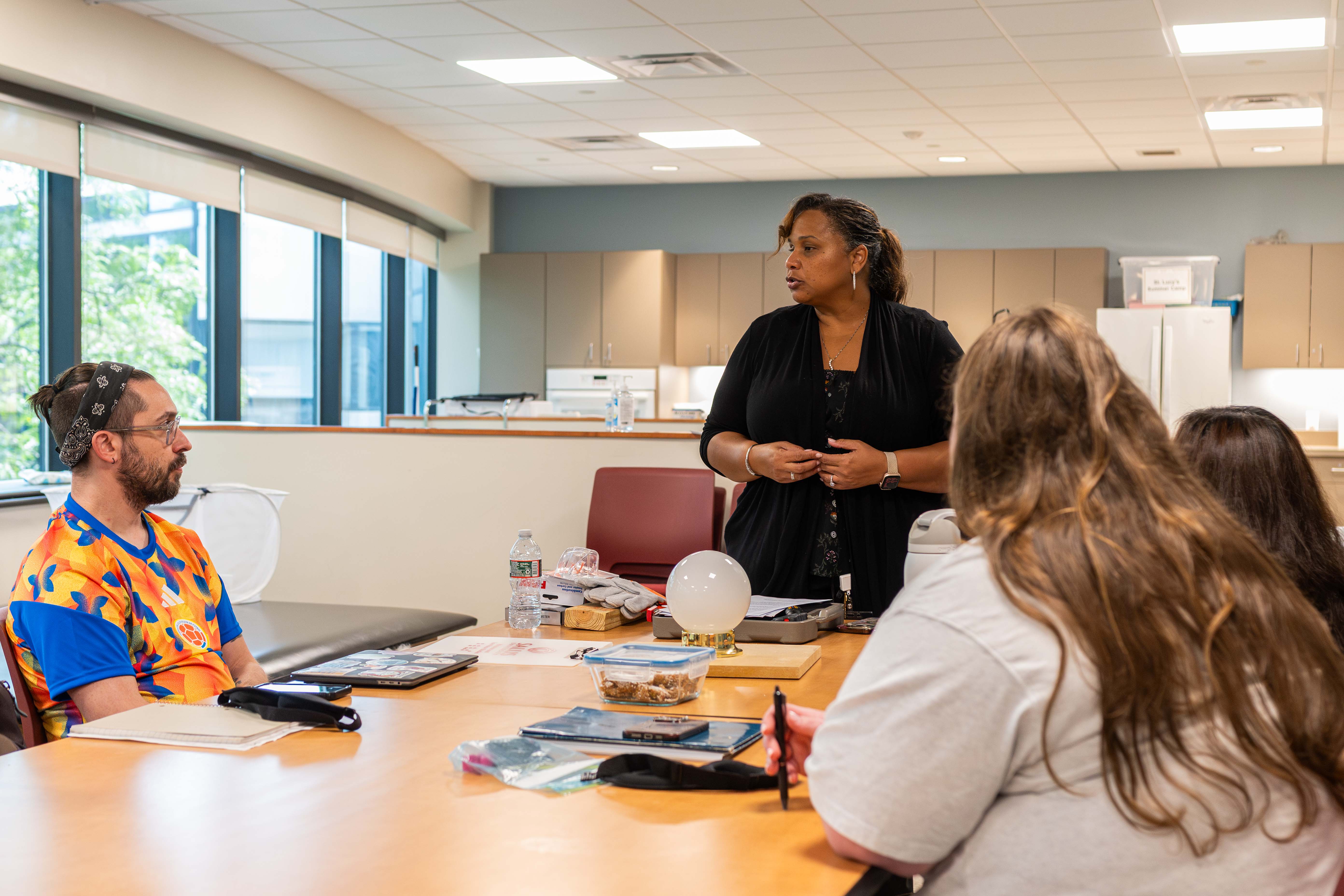 According to Lachelle Smith, MS ‘04, CVRT, LVT, VRT program director, students learn adapted daily living skills in all areas including home and personal management, medication and diabetes management, money identification and financial skills, recreation and leisure, communication, assistive technology, employment and transition, information and resource sharing, and basic home maintenance.
The VRT program is designed to teach students to serve individuals who are congenitally blind/visually impaired, as well as those with acquired (adventitiously) blind/visually impaired, and to improve the quality of life for those individuals with congenital visual impairment or vision loss by restoring independence; work with a broad and diverse population, including transition-aged youth through older adulthood; and demonstrate adaptive strategies and techniques for activities of daily living.
For Merielle Domingo ‘27VRT, the course has taught her various skills for helping those with low vision or blindness, such as preparing food over a stove, identifying money, cleaning, grooming and personal hygiene, labeling, and diabetes management. “Out of the many things I love about this program, the one that sticks the most is how it has classes on more than just rehabilitation skills,” said Domingo, who was born and raised in Washington State. She moved to Southern California after graduating high school and earned a bachelor’s degree in Psychology from the University of California, Riverside.
“This program teaches us the theories and foundations that we should know as VRTs, but it also teaches us the psycho-social and communication aspects of our learners,” she said. “It just reinforces what is repeatedly taught to us in each class: that the learner is at the center of what we do and what we do is for our learners. That’s the mentality I plan to continue after I graduate and get out into the profession.”
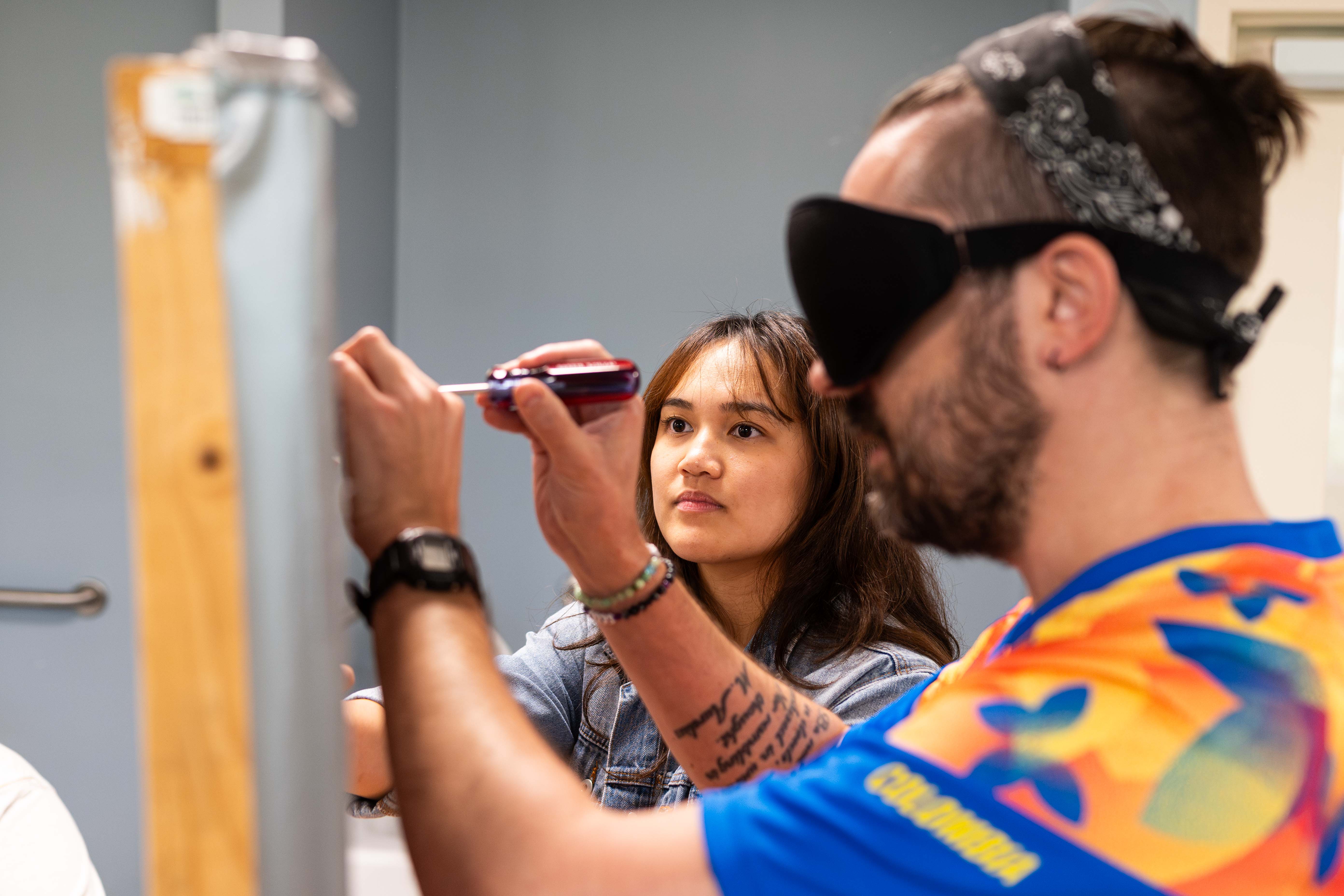 Mabery pointed out that in BLVS, no matter what discipline one is studying, there is only so much that can be learned in the classroom. That’s why the Independent Living Skills course and lab are so important to those in the program.
He believes that growth begets success and success begets a feeling of positivity. And that applies not just to the clients but to the BLVS professionals as well.
“That is precisely the point. A program of study, no matter what it is, should urge the learner to pursue more knowledge about the field/profession in which you are seeking a degree,” said Mabery. “In that context, it makes me eager to apply the skills I have learned in the classroom in real-life scenarios with future clients because every individual lesson is an opportunity to build on the knowledge that started here at Drexel.”