General News
Optometry
Alumni News

Since they were kids, Patricia Ramirez Rojas MSCO ‘26 and Ricardo Delgado MSCO ‘26 have shared just about everything. They met in high school, eventually married and trained together in optometry in Guadalajara, Mexico, as they worked toward their shared dream of becoming optometrists in the United States.
That led them to the Pennsylvania College of Optometry (PCO) at Drexel University in Elkins Park, Pennsylvania, where they both entered the Master of Science in Clinical Optometry (MSCO) program.
 They’ve spent much of their life side by side, and that togetherness continues. Today, both are participating in the Interprofessional Education for Collaborative Practice (IPECP) program at Drexel, a professional development opportunity that helps students develop and practice the competencies needed to provide collaborative care, including the attitudes, knowledge, skills, and behavior essentially to working effectively across professions. The program is offered through Graduate and Specialized Programming (GSP) at PCO.
Students interested attend a series of four Interprofessional Learning Activities (IPLAs) scheduled during non-didactic sessions. There are no credits or grades, but students who complete all four IPLAs, in sequential order, are awarded four microcredential badges, one for each of the four core competencies – Values and Ethics, Roles and Responsibilities, Communication and Teams, and Teamwork, plus a fifth, culminating badge. The badge is a displayable digital technology that represents competencies and various learning achievements.
“That is my dream, to be an optometrist in the United States. This program made me a better candidate for the Doctor of Optometry degree,” said Ramirez Rojas, who already had extensive clinical experience in Mexico. “I want to help people, give my knowledge to them. If they can see better, they will have a better quality of life.”
For Ramirez Rojas, the program offered her the opportunity to work with, learn from, and have discussions with other healthcare providers, which in turn gave her the opportunity to improve her clinical skills and ultimately provide better quality care to patients.
“I also tried to stay focused on communication and how the different providers can work together,” she said. “When health providers can communicate effectively and work together, we can give patients better attention.”
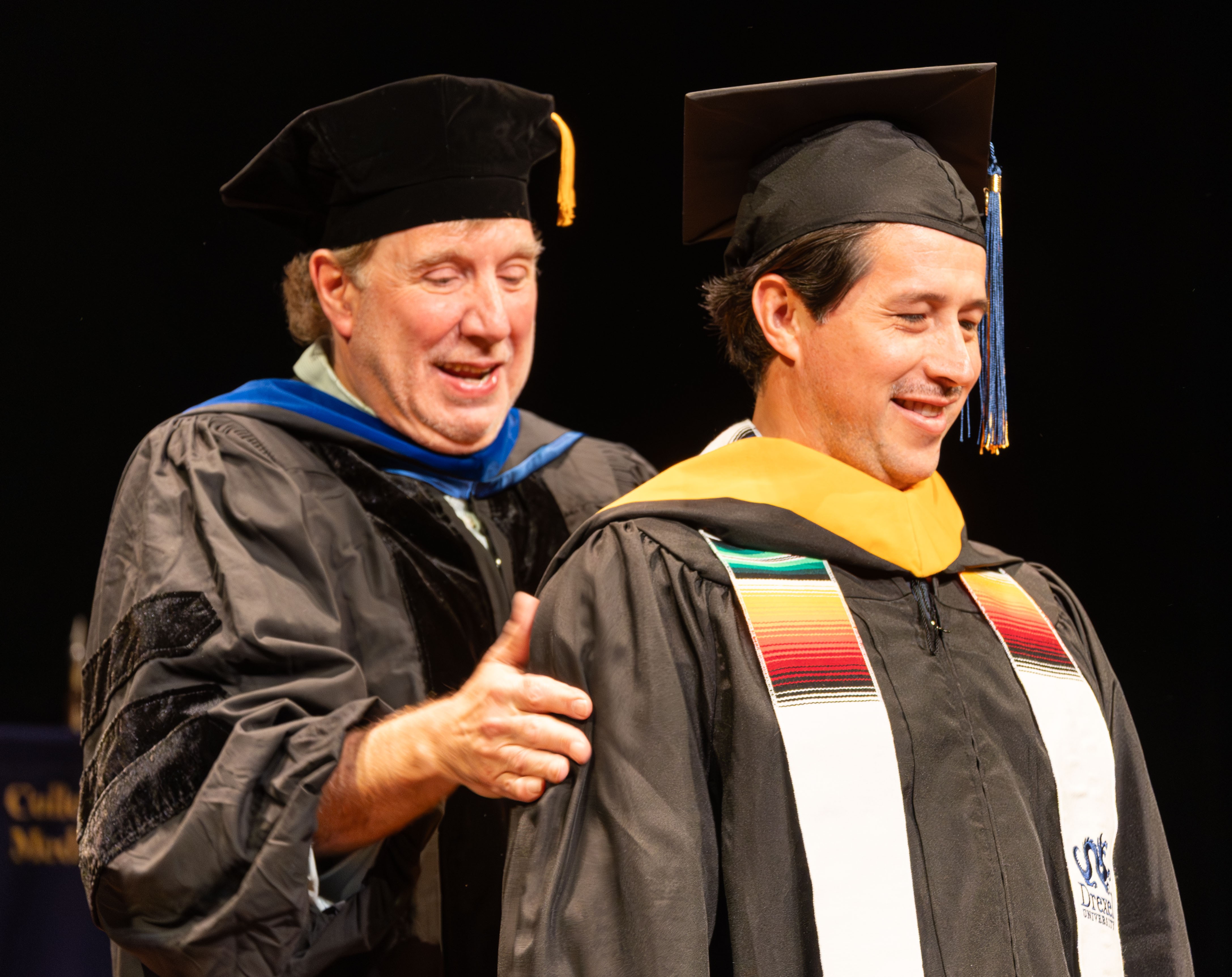 Delgado, who was born in Los Angeles but grew up in Mexico, studied to be a physician in that country but has always been involved in optometry. His mother is an optometrist, and he started working in her optical lab at the age of 14.
“My wife and I chose the IPLA program because it’s a way to connect with other colleagues and classmates,” said Delgado. “Sometimes when you study online, you kind of stay in a bubble. This program is a way to actually be involved.”
He added that one of the most valuable aspects of the program was the opportunity to learn from Drexel’s experienced faculty.
“The material is great. It takes you through the interprofessional component, which is meeting other classmates from other professions and having activities with them, like patient care and clinical cases,” said Delgado. “Having faculty and classmates from other professions being in the program is very enriching.”
Discussing clinical scenarios with other professionals from Osborne Audiology and the Salus at Drexel University Physician Assistant Studies’ programs, for example, helped improve the confidence of both Ramirez Rojas and Delgado.
“Looking at it from a more evidence-based medicine point of view helped me be more critical with myself, with my own bias, my own decisions,” said Delgado. “And, that of course, is going to translate in the future to better care management.”
The continuation of going through their educational experiences together translated seamlessly for the couple. They are, after all, used to being with each other constantly, both professionally and personally. “It’s a very passionate experience for us because we always work together,” said Ramirez Rojas. “We share everything. And, we really enjoyed being in this program together.”
She added that it’s important for the couple to set a good example for their three children. “Sometimes it’s difficult, but it’s all about teamwork,” said Ramirez Rojas. “We always talk about this because we really enjoy our time together and we’re focused on the same things. That’s a gift not every couple has. The opportunity to be here and be together is incredible.”
For questions about the IPCPe microcredential badge program, contact Ryan Hollister, MS, director of Bennett Career Services Center, at rth37@drexel.edu, or Melissa Vitek, OD ‘95, EdD, FAAO, PNAP, associate dean, Graduate and Specialized Programming, at mv649@drexel.edu or call 215.780.1235.