
Orthotics & Prosthetics
General News
Alumni News
Current Student News
One of the most valuable lessons students in the Orthotics and Prosthetics (O&P) program at Drexel University’s Elkins Park Campus learn is that growth often comes from tackling difficult challenges. This approach can lead to deeply rewarding educational experiences.
That’s exactly what O&P students Lanie Bainter ‘27MSOP and Adam Fields ‘27MSOP experienced recently when their academic poster “Toward a Gold Standard: A Review of Prosthetic Strength Testing and ISO 10328 Methodology” won the 2026 Edwin and Kathryn Arbogast Award at the American Orthotic & Prosthetic Association (AOPA) National Assembly in Las Vegas. The award is presented to the best prosthetic abstract submitted by a qualifying student or resident.
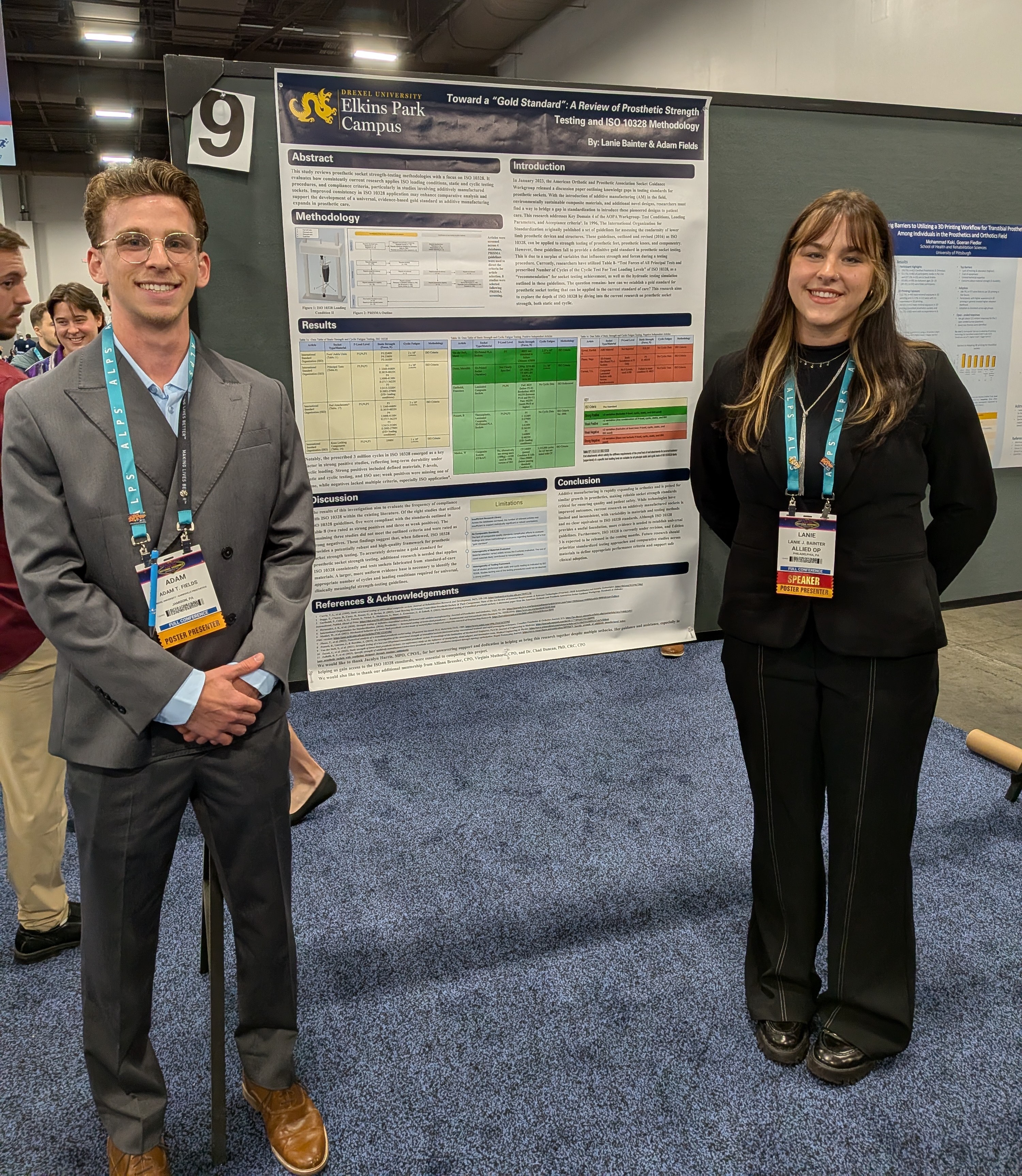 In the absence of standardized prosthetic strength testing protocols, students explored the difficult question of why and what can be done about it.
“Things like additive manufacturing (3D printing) are transforming orthotics and prosthetics (O&P) by replacing manual plaster casting and lamination with digital scan-to-print workflows, so the way sockets are produced is more standardized; therefore, you can eliminate a variable that prevents standardization,” said Bainter, an Ohio native who graduated from the University of Pittsburgh with a degree Rehabilitation Science.
She added that doing the research for this project taught her that one can have a big idea and that it’s OK if you can’t see every part of that idea through from beginning to end.
“We had hoped to run tests of our own and actually work in a lab and get some numbers,” said Bainter. “But the reality is you have to start somewhere else before you can think about going down that line. Being patient with the process and understanding that literature reviews are necessary to move onto higher levels of research, I think, was really important for us.”
The project got off the ground when Bainter approached Fields about being partners. Both a working relationship and friendship eventually developed during hours of research and exchanging ideas.
Fields said the project presentation in Las Vegas was the culmination of two years of hard work and he learned with determination and drive, he can tackle difficult challenges. “That’s exactly what our research was. It was a new thing, it was hard, and it was different,” he said. A native of Jamison, Bucks County, Pennsylvania, he earned his bachelor’s degree in Exercise and Sport Science from Temple University. Despite having no prior experience with 3D printing, he embraced the challenge. “I had no real background in 3D printing, but we learned it and excelled at it,” he said.
Fields is currently completing a rotation at Gainesville Prosthetics in Gainesville, Florida, where the shared mission is to help patients reach their goals, regain mobility, and, as he puts it, “give people their lives back.”
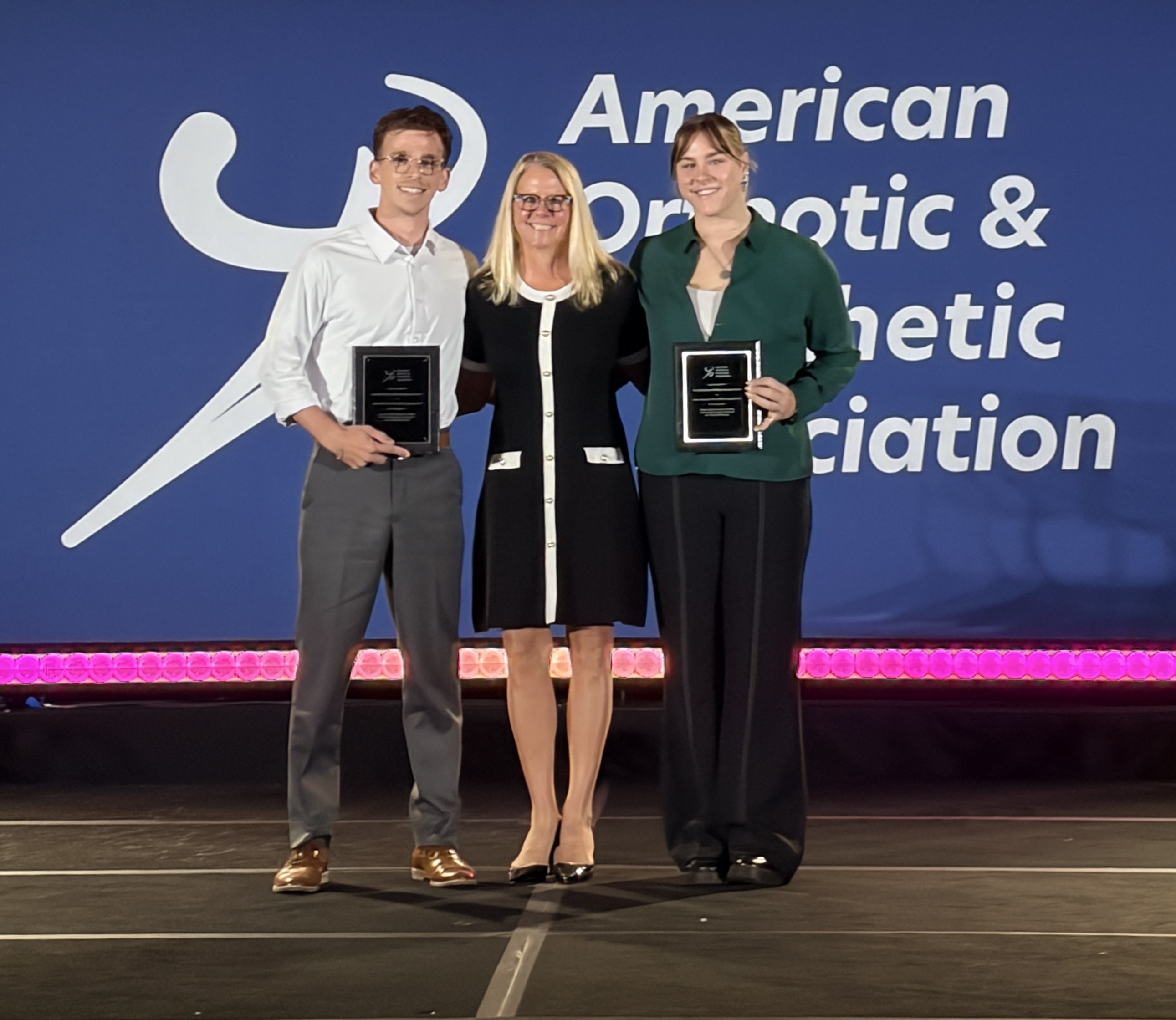 He added that mission reflects exactly what students learn in the Drexel O&P program: how to think critically, troubleshoot challenges, and develop problem-solving skills to make a meaningful difference in patients’ lives.
“I only have to work 32 hours a week, but I’m here 50-plus hours a week because I want to be here,” said Fields. “I think the Drexel program teaches you that we’re here to change lives.”
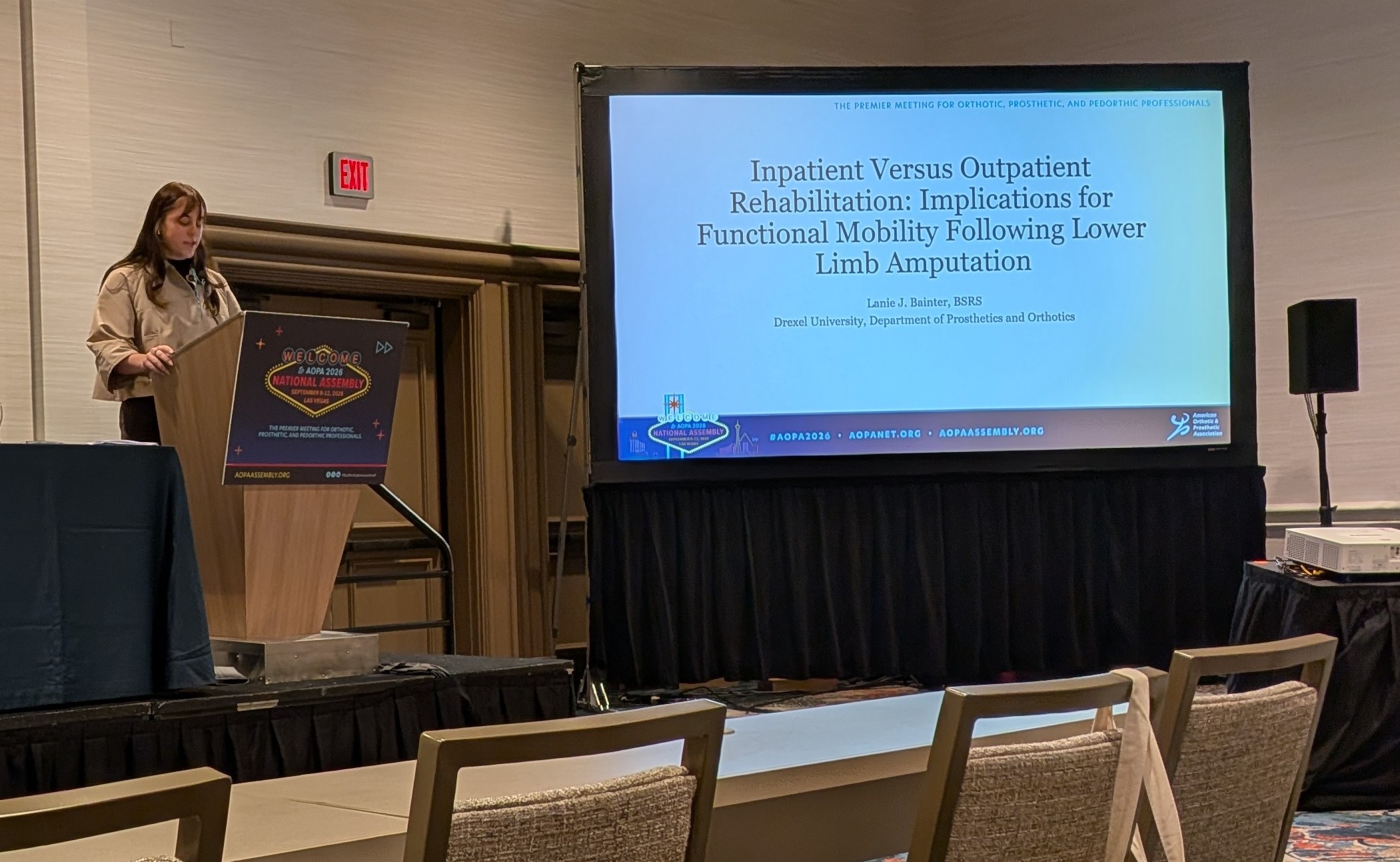
In addition to the prosthetic strength testing poster, Bainter also presented a review titled “Inpatient Versus Outpatient Rehabilitation: Implications for Functional Mobility Following Lower Limb Amputation” at the Las Vegas conference. “That was something I wrote myself. When I started my residency, I was very integrated with a hospital. Just seeing rehabilitation there made me question why every patient doesn’t have the opportunity to do an inpatient intensive,” said Bainter. “So, I looked at reasons why and why it’s proven to be more significant to do intensive inpatient rehab early on in the recovery period.”
Both Bainter and Fields said they are interested in conducting more research down the road and presenting at AOPA was an awesome experience.