Current Student News
General News
Orthotics & Prosthetics
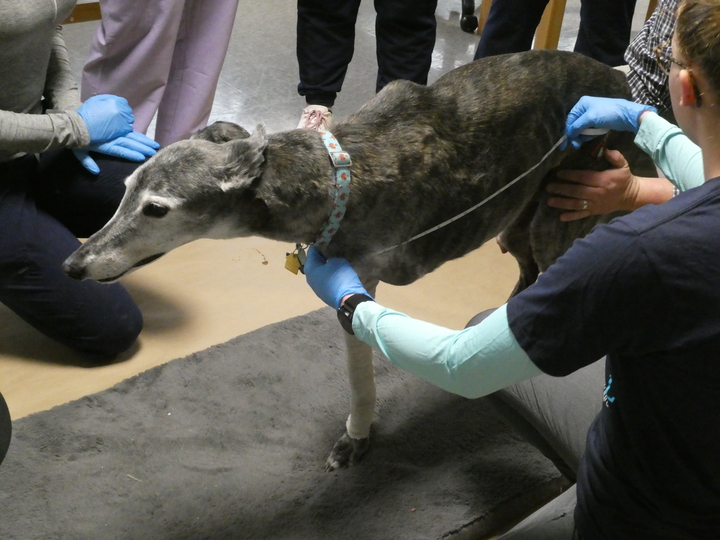
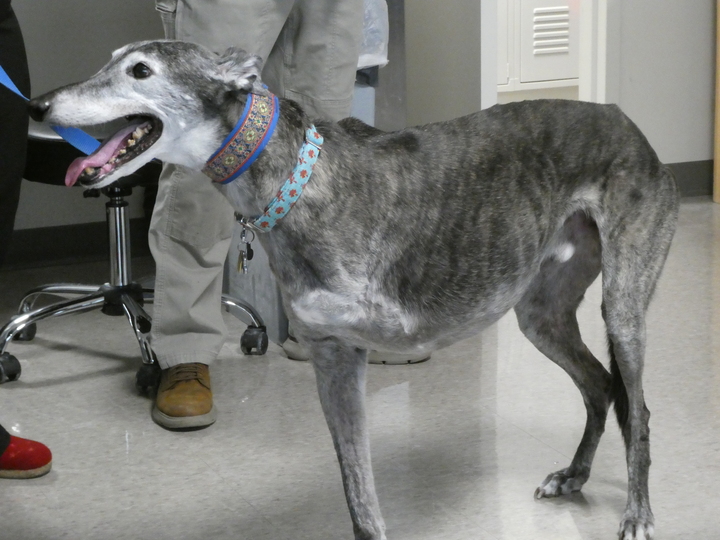
As a self-proclaimed “dog person,” Becca Hanoka ‘28O&P, a first-year master’s student in the Orthotics and Prosthetics program at Drexel University, was looking forward to a project where she and her classmates would be casting a prothesis for a three-legged dog named Oliver.
“This was the first time I’ve ever casted an animal and for me, it was exciting and rewarding,” said Hanoka, who supported Oliver through this new experience by showing him love during the process. Oliver returned the favor by being relaxed and confident enough to fall asleep in her lap.
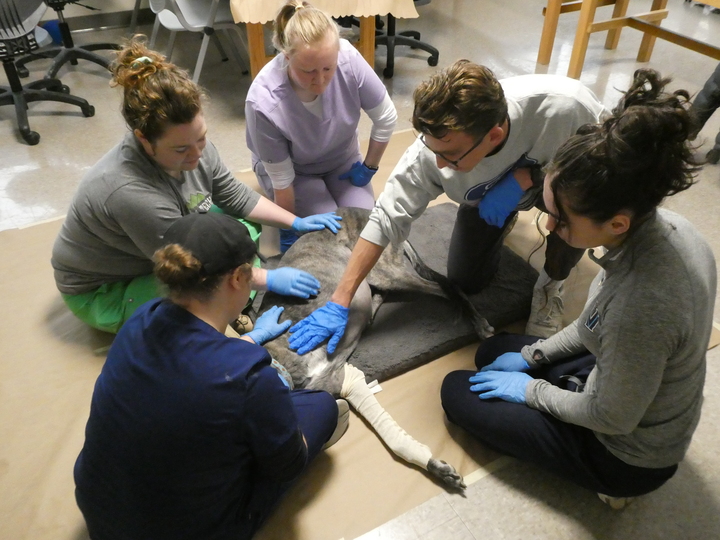 Oliver is one of four racing greyhounds rescued by Erin Jenewein, OD, MS, Diplomate, and her husband Darryl Horn, PhD, FAAO, both faculty members on Drexel's Elkins Park campus, when the couple lived in Florida. A little more than four years ago, the dog lost his entire left front leg to bone cancer.
“We had always been curious about a prosthesis for Oliver and we talked to some of the O&P students and thought he’d be a great model for them to see if they could learn from him,” said Dr. Jenewein, associate professor and coordinator of the Pediatric/Vision Therapy residency program in the Pennsylvania College of Optometry. “He does see his oncologist every three months and gets a lot of testing done. He’s fought through chemo and immunotherapy after surgery so he’s used to people learning from him and petting him and touching him.”
Dr. Horn, associate professor and director of the Post-baccalaureate program in Health Sciences and of graduate programs in Biomedicine on the Elkins Park campus, added the couple didn’t necessarily think Oliver needed a prothesis for movement or motion, but more for stability when standing.
“So, when the O&P department was launched (in the fall of 2022), we always had in the back of our minds whether there was something the students could do for him,” said Dr. Horn.
The main difference between casting a prothesis for a human patient model and an animal patient model is obviously communication.
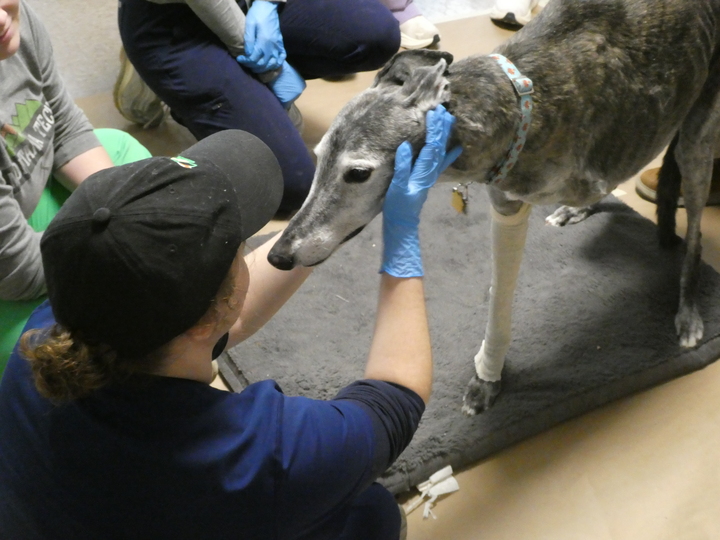 “With humans, they can tell you what hurts and where it hurts,” said Virginia Muthard, CPO/L, FAAOP, assistant professor in the O&P program. “Animals cannot give you verbal feedback, so there are a lot more visual cues that you have be tuned into. And you have to be an animal person to some degree.”
Muthard said going through the entire process of making a prothesis for Oliver would take a month or two. She added that it’s a somewhat complicated case in that the dog doesn’t have any residual of a limb to which a prothesis can be attached.
“I feel like there is a longer break-in time for animals because they don’t necessarily understand that we’re trying to do something good for them,” she said. “And we want to do it slowly so they don’t get turned off. We want them to accept and enjoy it, so if they have a really bad experience with it up front, they may completely reject it.”
For Oliver, students started by doing an evaluation of the patient with the goal of making a successful impression that could be used to make a prothesis. In Oliver’s case, because he’s missing any residual of the limb, students had to take a body impression of the dog’s entire chest for a suspension that would wrap around and be anchored to his right front leg.
Although she had previously observed a dog being cast, it was the first time Maddie Gedaka ‘27O&P, was personally involved in the process. She said the communication aspect alone created challenges for the students. For example, when team members were taking Oliver’s measurements, the dog’s legs began shaking uncontrollably.
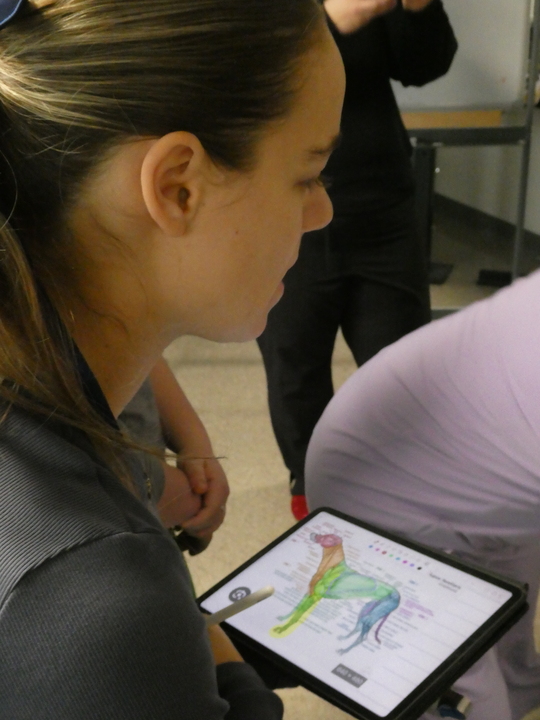 “At that moment, we recognized that he needed to sit down and rest,” said Gedaka. “In this exercise, you are working entirely on the animal’s time. It’s important to balance completing the required tasks while also giving the animal breaks when needed.”
For both Hanoka and Gedaka, casting an animal was a tremendous learning experience they believe will help them become better clinicians in the future.
“This experience helped me with my skill set by having me think out of the box in various ways. Not just with the design process but also communication and working as a team,” said Hanoka. “This helped advance my professional career by showing me some challenges I might face and how I will approach trial and errors. With that I can learn from them and build on them to create a product or device that my client and I are both proud of.”
For Gedaka, the experience provided her with a leadership opportunity to work as a team with her classmates.
“In addition to learning what it’s like to cast an animal, I gained valuable experience leading a group effectively,” said Gedaka. “These skills are essential as we move into residency, where we will regularly collaborate with other clinicians and interdisciplinary teams.”
Reflecting on how the experience will translate to future clinical practice, the students found the development of these skills necessary for long-term success in their future careers.